
Research peptides | Product specifications | Order support
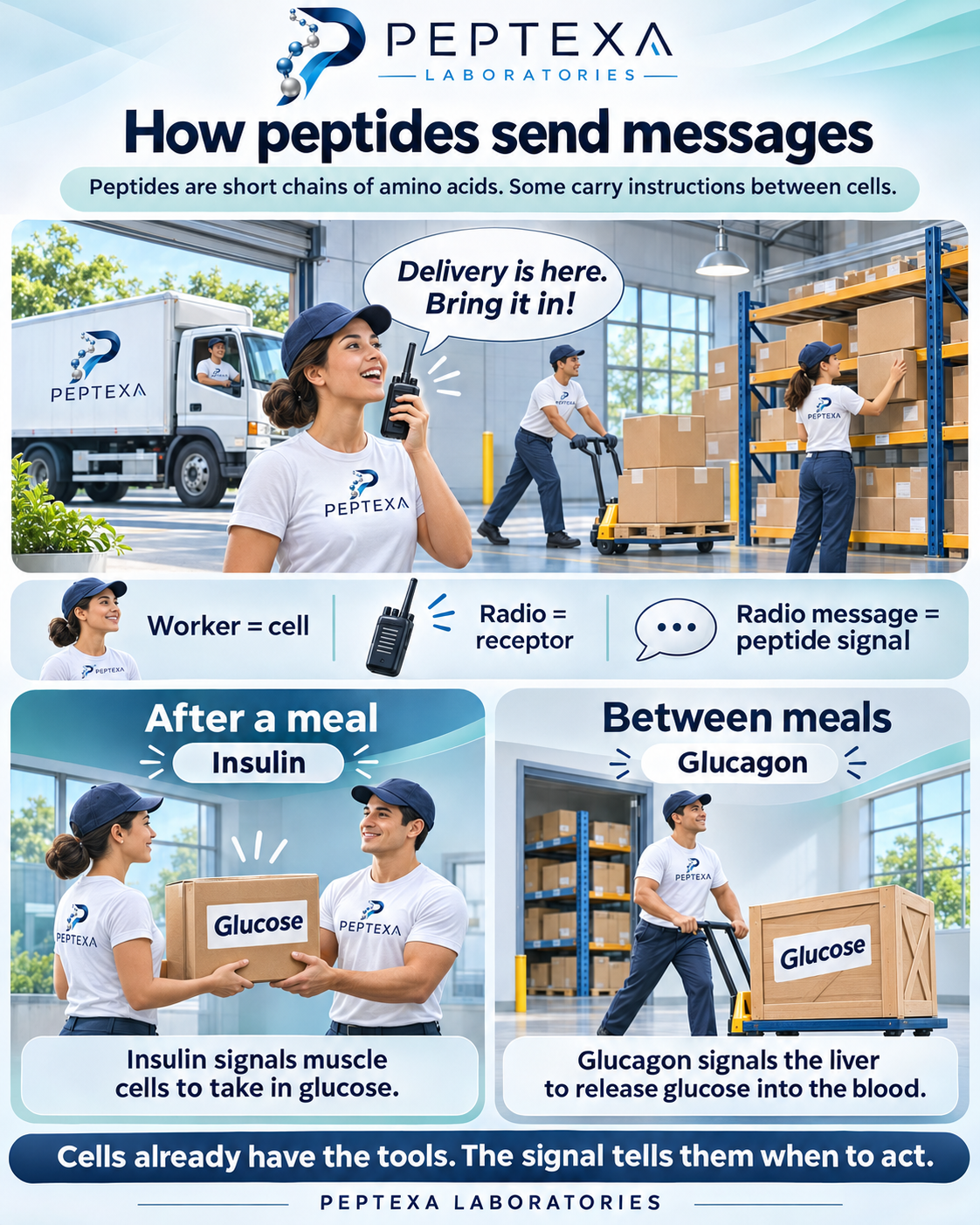
Peptides are short chains of amino acids, the same building blocks your body uses to make proteins. Your body naturally makes many different peptides, and some of them act as chemical messengers. They let one part of the body tell another what needs to happen. After you eat, for example, your pancreas can send a message that helps your muscles take up sugar from your blood and use it for energy.
Imagine your body as a workshop
Picture a workshop full of skilled workers. The tools are on the bench, the machines are ready, and each team knows its job. A lorry pulls up with a delivery. The workers in the storeroom can unload it, but from where they’re standing, they can’t see that it’s arrived. Then a message comes over the radio. “Delivery is here. Bring it in!” The team picks up its tools and gets to work.
In this comparison, the workers are your cells, the tools are the machinery inside them, and the message is the signalling peptide. What looks like a team standing idle can be a team waiting for the right instruction. The workers get their energy from food. What the message gives them is direction. Depending on what the body needs, that direction might be to increase an activity, slow it down, or release something another part of the body needs.
How does the message reach the right cells?
Many signalling peptides work by attaching to a receptor, a protein on the surface of a cell. Think of the receptor as the workshop radio tuned to a particular channel. A peptide can travel through the bloodstream and pass many cells along the way. A cell with a matching receptor can pick up the signal. When the peptide attaches, it sets off a series of changes inside that cell, putting its own machinery to work.
You can see this in the way your body manages blood sugar. After a meal, your blood sugar rises and your pancreas releases insulin. One of its messages to your muscle cells is, in effect, “There’s fuel available. Take it in.” The muscles can use that sugar now or store it for later. Between meals, as blood sugar falls, your pancreas releases another peptide hormone called glucagon. Its message to the liver is, “We need some of that fuel back.” The liver responds by releasing glucose into the blood.
That’s what it means to say your body already has the tools. Your muscles already have the ability to take up fuel, and your liver already has the ability to release it. Signalling peptides help those organs coordinate their work so that fuel is stored when it’s plentiful and made available when it’s needed.
WhatsApp us